
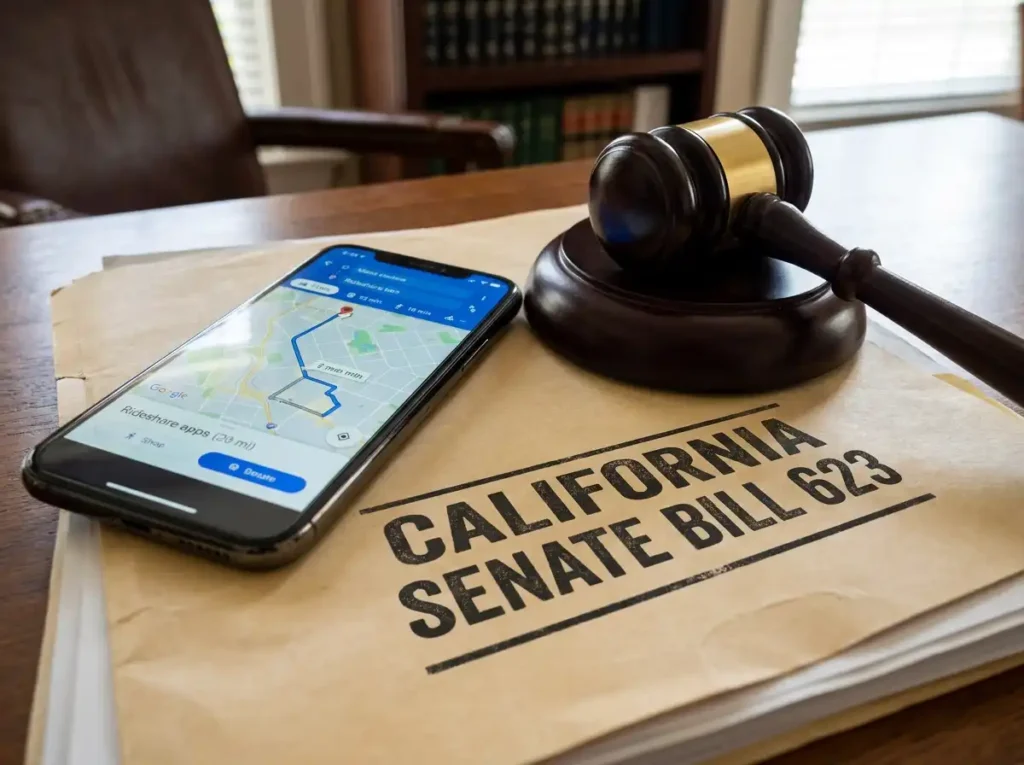
This legislation represents an eleventh-hour compromise between major rideshare networks like Uber and Lyft and consumer advocacy groups, effectively altering the financial trajectory of personal injury claims overnight. If you are a passenger, driver, or pedestrian injured in a rideshare incident, understanding SB 623 is no longer optional—it is the difference between securing a fair settlement and being left buried under a mountain of uncompensated medical debt.
The Backstory: The Midnight Compromise That Bypassed the Ballot
 To understand why California Senate Bill 623 moved through the legislature with such blinding speed, one must look at the high-stakes political chess match that preceded it. Consumer advocacy groups and trial attorneys had successfully positioned aggressive punitive measures on the upcoming November 2026 ballot. These measures threatened to strip tech platforms of their prized protections and expose rideshare giants to massive corporate liability for driver negligence.
Facing the prospect of an expensive, unpredictable ballot war, Uber and the Consumer Attorneys of California (CAOC) struck a sweeping compromise. The restrictive ballot measures were pulled. In their place, SB 623 was fast-tracked through Sacramento and signed by Governor Newsom. The result is a balanced bill that alters how medical bills are evaluated while simultaneously introducing strict new safety protocols for rideshare networks operating across the state.
The 70th Percentile Rule: How SB 623 Caps Medical Liens
The most consequential component of California Senate Bill 623 centers on how medical liens are handled in personal injury litigation. Historically, when an uninsured or underinsured rideshare accident victim required specialized medical care—such as orthopedic surgery, advanced imaging, or extensive physical therapy—they often turned to medical liens. Under a lien agreement, medical providers treat the patient with no upfront costs, agreeing instead to receive payment directly from the final legal settlement or court judgment.
Because providers face the risk of never getting paid if the case loses, lien-billed rates have traditionally been significantly higher than standard health insurance or Medicare reimbursements. Defense attorneys frequently argued these bills were artificially inflated to drive up the “special damages” portion of a lawsuit, which in turn inflates pain and suffering multipliers.
SB 623 directly targets this mechanism by introducing a strict statutory cap. Under the new law, the maximum recoverable amount for any medical service rendered on a lien basis in a rideshare accident case is capped at the 70th percentile of the FAIR Health database for that specific geographic region. The FAIR Health database is a nationally recognized, independent index that tracks what providers actually charge for specific medical codes across distinct zip codes.
What this means for your claim: If a surgeon bills $20,000 on a medical lien for a procedure following an Uber crash, but the 70th percentile for that specific procedure code in your county is indexed at $12,000, a jury or insurance adjuster can only consider the $12,000 figure as the maximum reasonable value of that medical care.
While this prevents the defense from claiming that the medical bills are completely unanchored from reality, it also means that plaintiffs and their attorneys must carefully audit medical charges from day one. If a provider charges significantly above the 70th percentile, the injured victim could theoretically be left exposed to the balance unless their legal team proactively negotiates the liens down to conform with the new statutory baseline.
New Anti-Self-Dealing Rules for Personal Injury Attorneys
In addition to capping the dollar amounts of medical liens, California Senate Bill 623 imposes strict ethical and operational guardrails on how personal injury law firms interact with healthcare providers. The law introduces aggressive anti-self-dealing transparency measures designed to eliminate hidden conflicts of interest.
Effective immediately, contingency-fee attorneys are legally barred from referring clients to lien-based medical clinics, imaging centers, or surgical centers in which the attorney, their law firm, or immediate family members hold a financial stake or ownership interest. If any such relationship exists, it must be disclosed explicitly in writing to the client and the defense from the onset of representation.
This component of the law aims to restore total objectivity to the medical treatment pipeline. For victims, this ensures that the medical care they are directed to is chosen solely because it is optimal for their physical recovery, rather than because it benefits the financial bottom line of a joint legal-medical business enterprise.
The Safety Trade-Off: Annual Background Checks and Gender-Matching Features
 Because California Senate Bill 623 was a compromise bill, the restrictions placed on medical damage recoveries were paired with enhanced consumer safety mandates that rideshare companies must fund and enforce. These provisions look to proactively reduce the frequency of physical altercations, accidents, and assaults occurring within active rideshare windows.
1. Mandatory Annual Criminal Background Re-Checks
Prior to the passage of SB 623, background check intervals for rideshare drivers left room for gaps, allowing bad actors to remain active on platforms for extended periods after a disqualifying offense occurred. The new law mandates that Uber and Lyft execute comprehensive criminal and driving record background checks **every 12 months** without exception. Failure to run these checks on an active driver subjects the platform to steep regulatory fines and creates a presumption of corporate negligence in subsequent personal injury lawsuits.
2. Optional Passenger-Driver Gender Matching
Addressing years of highly publicized litigation regarding sexual assault and harassment during rideshare trips, SB 623 legally formalizes a framework for specialized matching features. The act requires tech platforms to roll out optional systems allowing women drivers and women passengers to request one another preferentially. This layer of security aims to offer peace of mind to vulnerable commuters traveling late at night, directly addressing passenger safety before an incident can occur.
Navigating the Combined Impact of SB 371 and SB 623
To successfully litigate an Uber accident claim today, you must look at SB 623 in tandem with the previously passed SB 371. The legal ecosystem has tightened from both ends:
- The Insurance Squeeze: SB 371 reduced the available third-party and UM/UIM policy limits down to $60,000 for many California accident scenarios, drastically reducing the pool of available insurance money.
- The Damages Squeeze: SB 623 now caps the medical special damages you can claim via liens to the regional 70th percentile of FAIR Health data.
Because there is less insurance money on the table and stricter limits on how medical expenses are counted, building a pristine evidentiary record is non-negotiable. It requires working with legal professionals who understand how to properly utilize the FAIR Health database to maximize your medical valuation while keeping bills within the enforceable, recoverable limits of the law.
Protect Your Rights Under the New Law
The Fair Medical Billing & Rideshare Safety Act changes how personal injury cases move through California courts. If you find yourself injured in an Uber or Lyft accident, do not assume old legal strategies apply. Ensure your medical treatments are documented precisely, your liens are structured within the 70th percentile framework, and your legal representation knows how to hold rideshare networks accountable under the newest June 2026 guidelines.